Saturday 10am-3pm
Wednesday 11am-3pm


by Jovette Hiltunen
This epic stands beside the literature of the world including The Iliad, The Odyssey, Beowulf, and the Song of Hiawatha. It has stood the test of time having come from a unique type of song developed into poetry from 2500-3000 years ago. And one of our curators, Janine LaBounty, brought it to us through the magic of jewelry. Did you guess it? Yes, it’s the Kalevala. Even today, in 2026, the Kalevala remains in the center of Finnish literature.
So what does this have to do with jewelry? The culture, the life, the magic, the history, status and wealth of Finns can be found in the Kalevala Kora, “A Story to Tell”. Like all great stories, the Kalevala jewelry had its ups and its downs as it followed the pagan world of the Gods to present day Christianity.
In the early 1800’s there was a growing need for Nationalism in the arts, poetry, and old tales. Väinämöinen entered as a sage, poet, singer, kantele player. In the 1820’s Elias Lonnrot was working on his thesis for his masters degree. He was looking for everything possible on Vainamoinen. He began collecting the folklore and found his first songs in the Kalevala meter. By 1834 he had so many materials he had enough to complete 7 different books like the Kalevala. The Kalevala symbolizes all that was Finnish and remains a source of inspiration today. The Kalevala holds themes of relationships, magic spells, love, death, and trickery.
So how do we pull this wonderful epic into jewelry? Let’s look at some of the runos (songs, poems) that are mentioned in the Kalevala. There is Aino, the sister of Joukahainen, who is to be wed to Vainamoinen. Distraught and searching, Aino goes off into the woods where she meets the Maidens of the North. They wish to adorn her with golden pins and earrings and silken ribbons. But Aino cannot overcome her grief and tosses her jewelry away. She drowns herself in the sea. In Runo 10 we meet Ilmarinen the Smith where he is supposed to forge the Sampo but we also learn of his craft of silver and gold ornaments for his family and the people of Kalevala. Ilmarinen is to be wed and in Runos 22 and 24, his bride is given rings, bracelets and necklaces to show both her beauty and her family’s wealth. In Runo 49, the sun and the moon are stolen. Ilmarinen forges new ones of gold and silver hoping to restore light to the world. These mythical descriptions as well as the ancient archaeological finds of the era when the Kalevala was written were the first inspirations for the Kalevala Jewelry. In the Kalevala you will note that jewelry is mentioned as wealth and beauty for the families. And then of course are the Iron Age replicas such as pendants with birds, webbed feet for fertility, peacocks for immortality, the bear for its power, also thought to be half human and half forest being.
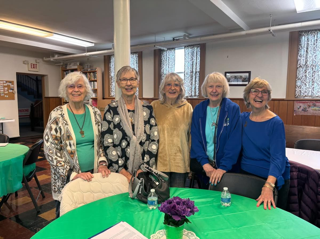
The jewelry called Kalevala Koru began in 1930 as a project led by women to celebrate Finnish heritage. Interestingly, it remains the largest jewelry manufacturer in Finland. It began with an idea by Elsa Heporauta and a social group wishing to fund a statue for the “Finnish woman.” The group eventually became the Kalevala Women’s Association and still exists today. The group would produce 40 pieces of jewelry which were replicas of ancient Iron Age jewelry as found in the Finnish National Museum. The pieces were designed by Germund Paaer and shown at a tea party hosted by First Lady Kaisa Kallio in December 1937. The pieces sold out immediately. Indeed, during the first month they sold 8000 pieces of the jewelry that were reproductions of ancient museum jewelry. Many of the members of the museum wore this jewelry at our gathering at the program as seen in the group picture above. The designs they chose harkened to the times of the Kalevala poems, hence the name Kalevala Koru. The statue project was put on pause in 1939 due to the outbreak of World War II. Instead the women used the earnings from the jewelry to fund various humanitarian aid to support war widows and orphans. The company is still a non-profit organization of 4,000 women and they continue their good works by promoting and revitalizing Finnish cultures and traditions. The statue was completed in 1945 and was called Louhi, Mistress of the North. (www.kalevalashop.com) Emil Halonen sculpted it out of bronze and it is located at the Kalevala Koru headquarters in Pitajanmaki, Helsinki, Finland, though it originally was in a lobby of a manor house.
The replicas were historical but in the late 1940s, the Kalevala Koru began introducing modern jewelry that reflected the culture of the times. It was in 1963 that Paula Haivaoja became the company’s first female chief designer. Today the common symbols that were found in epic and modern collections include the St. John’s Arms (as modeled by member Ken Quiggle). This is a cross that protects the wearer. Bear and bird motifs as well as other animals also are included in the more modern jewelry. Duplicates of the Kalevala Koru can be found in many areas. To check to see if yours is authentic, look for this mark on your jewelry. Kalevala Koru Maker’s Mark No presentation on the Kalevala and Kalevala Koru would be complete without actually seeing the jewelry. Many of our members came to the meeting wearing both Kalevala jewelry and Marimekko clothing. The pride in the history and SISU of our Finns was well represented. Member Ken Quiggle wore a replica of Thor’s hammer. Thor was the Viking God of Thunder and wearing the hammer was thought to fight evil. We have a small selection of jewelry at the museum and many of our members have bronze replicas of the original 40 pieces.
Part of the wonderment of any museum is to see how the people of a time and place represented what they believe in, what they worship, what they hold sacred, as well as to see what traditions and cultural beliefs stood the test of time. The Kalevala has held the test of time and Finns all over the world cherish these little pieces of an Epic that continues to breathe life in the SISU of a Nordic country.